
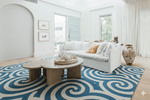
How to Style a Traditional Rug as a Shyrdak in a Modern Interior
, by Kyrgyz HANDMADE, 11 min reading time
, by Kyrgyz HANDMADE, 11 min reading time
Most people talk themselves out of a traditional rug the moment they imagine it next to modern furniture. Interior designers say that's the wrong instinct. The right pairing doesn't clash — it creates exactly the depth and character that all-matching rooms lack. Here's how to make it work, room by room.
There's a moment most people experience in a rug store — or on a product page — where they fall for something with bold pattern and deep color, then talk themselves out of it. Too traditional. Too busy. It won't go with my furniture.
That instinct is almost always wrong.
Some of the most compelling interiors in 2026 are built on exactly this tension: clean, contemporary furniture grounded by a rug with genuine history and character. The combination works not despite the contrast, but because of it. This guide shows you how to make it happen — practically, room by room.
Interior designers have a phrase for what happens when a space is assembled entirely from items of the same style and period: it looks like a showroom. Everything matches. Nothing feels lived in.
The most interesting interiors are layered — they mix periods, textures, and cultural references in a way that feels curated rather than coordinated. A traditional rug is one of the most effective tools for achieving this.
Many 2026 trend forecasts point to an ongoing appreciation for craftsmanship, heritage influences, and interiors that feel personal rather than staged — spaces with character and longevity. Rugs with traditional patterns, subtle irregularities, and handmade origins sit naturally within this direction because they bring exactly those qualities: authenticity, depth, and a sense that the space was assembled by a person, not a algorithm. Love-Rugs
After years of pale neutrals and cool grays, 2026 interiors are welcoming a deeper, more indulgent palette — richer earth tones, cocooning textures, and patterns that carry visual weight. A traditional rug doesn't fight this direction. It leads it. Homes and Gardens
Before getting into specific rooms and techniques, there's one principle that governs all of it:
When a traditional rug with bold pattern sits in a space, the surrounding furniture and walls need to be quieter. Simple silhouettes. Neutral upholstery. Clean surfaces. The rug earns its complexity by anchoring a room that doesn't compete with it.
This is the mistake most people make when they try to mix styles and it doesn't work: they keep both the rug and the furniture visually loud. The result is chaos. The solution isn't to remove the rug — it's to simplify everything else.
The living room is where a traditional rug performs best, because it has a clear job: define the seating area and give the room its gravitational center.
The right approach: Start with the rug, then select furniture. Most people do the reverse — they buy a sofa, then look for a rug to match it. When the rug comes first, the rest of the room follows its lead naturally.
Place the rug so that at minimum the front legs of all seating pieces rest on it. Ideally, all legs sit fully on the rug. A rug that floats in the center of the room without connecting to the furniture looks like an afterthought, regardless of its quality.
Color strategy: A traditional rug with multiple colors is an asset, not a problem. Pick one secondary color from the rug — not the dominant one — and carry it into two or three accent pieces: a throw pillow, a ceramic object, a plant pot. This creates cohesion without making the room feel matched.
What to keep simple: If the rug is bold, the sofa should be solid and neutral. Linen, boucle, and velvet in warm neutrals — cream, sand, warm gray, charcoal — work particularly well alongside patterned traditional rugs. Avoid patterned upholstery.
The bedroom is often the room people hesitate most to use a traditional rug — and it's frequently where it works best.
The partial-under-bed placement is the most effective. It grounds the bed visually, adds texture and warmth underfoot where you step in the morning, and doesn't require the rug to fill the entire floor.
Styling logic: In a bedroom, the rug competes with bedding. Keep bedding in solid, muted tones and let the rug carry the pattern. Linen bedding in natural off-white works with almost any traditional rug palette.
Scale matters: In smaller bedrooms, a runner (rather than a large area rug) can provide the same visual warmth without overwhelming the space. Two runners flanking the bed is a solution that works in rooms where a full rug would look crowded.
The hallway is the most underused real estate in most homes, and a traditional runner transforms it completely. It's also a low-risk environment to experiment with bold pattern — there's no furniture to coordinate, and the narrow format of a runner contains the design naturally.
Designers are pushing for rugs that define zones, especially in transitional spaces — pieces that add dimension without committing to a single statement. A hallway runner does exactly this: it adds character to a transitional space without requiring a design overhaul. Lynnegreeneinteriors
Practical note: Hallways get more concentrated foot traffic than any other area. This is where a handmade wool or felt rug proves its durability advantage over synthetic alternatives — the material holds up where cheaper options deteriorate quickly.
Many people avoid pattern in the dining room because they worry about visual conflict with chairs. The opposite is usually true — a patterned rug under a dining table grounds the furniture arrangement and makes the room feel intentional.
The key rule: size. The rug must extend at least 60–75 cm beyond the table on all sides. When chairs are pulled out, they should still sit fully on the rug. A dining room rug that's too small is the single most common mistake in this space.
Chair selection: Simple, slender chair legs — particularly in wood or metal — work well over traditional rugs. Upholstered chairs in solid fabric are also fine. Avoid heavily patterned chair fabric if the rug carries strong pattern.
Matching colors from a traditional rug to modern furniture doesn't require a designer's eye. These combinations are reliable:
Bold rug + warm neutrals: Rich reds, deep blues, or jewel-toned patterns against linen, raw wood, and warm white walls. Classic combination that photographs well and ages beautifully.
Dark rug + light room: A rug with dark tones — charcoal, navy, deep burgundy — in a light-walled, well-lit room creates strong contrast that feels intentional rather than heavy.
Earthy rug + natural materials: Terracotta, rust, and ochre-toned traditional rugs pair naturally with rattan furniture, ceramic accessories, and raw linen. This combination aligns directly with where interior design is moving in 2026.
Neutral rug + one bold accent: If the rug's palette is understated — cream, grey, and black — the room can carry more personality in other elements without becoming chaotic.
Choosing a rug that's too small. The most frequent error. A rug that doesn't connect the furniture looks like a bath mat in the center of the room. When in doubt, size up.
Matching too literally. If you try to match the rug's red to the exact red of your cushions, you will fail — and the room will look forced. Instead, use the rug as a palette, and select one or two colors from it to appear elsewhere in small doses.
Placing the rug in a dark room. Traditional rugs with rich color need light to read correctly. In low-light rooms, the pattern flattens and the colors look muddy. Supplement with warm lighting if natural light is limited.
Ignoring scale. A small rug with a large, bold pattern looks chaotic. A large rug with a small, delicate pattern can disappear. Match pattern scale to room size — larger rooms carry larger, bolder patterns; smaller rooms do better with more contained motifs.
Shyrdak felt rugs from Kyrgyzstan occupy a specific design territory that most traditional rugs don't: their patterns are bold and geometric, but their palette tends toward high contrast — deep reds and navies against cream and black, or earthy ochres against charcoal. These are not the complex multi-color palettes of Persian or Turkish rugs. They're cleaner. And that makes them more adaptable to modern interiors.
A Shyrdak with a black and white pattern works in a Scandinavian-influenced room with the same ease it works in a maximalist eclectic space. A red and navy Shyrdak anchors a contemporary living room without requiring the entire room to change its character.
Beyond aesthetics, each Shyrdak is genuinely unique — produced by hand, in Kyrgyzstan, using a felting technique inscribed on the UNESCO Intangible Cultural Heritage list in 2012. In a design era where authenticity and traceable craft are increasingly valued, that provenance matters. By 2026, homeowners are moving toward uniqueness and artisanship — handmade details, artisanal motifs, and slow-made constructions that create pieces with genuine character. A Shyrdak is exactly that object.
A traditional rug doesn't ask you to redesign your home around it. It asks for space to breathe — simpler furniture, quieter walls, and the confidence to let the pattern do its work.
The combination of heritage craft and contemporary interiors isn't a compromise. It's a design choice that produces rooms with character, depth, and longevity — the kind that look better in ten years than they did when the furniture was new.
Browse our collection of handmade Shyrdak felt rugs — each one a unique piece produced by Kyrgyz artisans, ready to anchor any modern interior.