
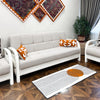
Best Rugs for Living Room: What Interior Designers Look For
, by Kyrgyz HANDMADE, 15 min reading time
, by Kyrgyz HANDMADE, 15 min reading time
nterior designers don't choose living room rugs by feel — they work from a framework: size first, then material, pile height, color logic, and placement. Get any one of these wrong and the rug looks off, no matter how good it looked in the store. Here's the exact criteria professionals use, explained clearly.
Most people choose a living room rug the wrong way. They find something they like the look of, check that the color roughly matches the sofa, and order it. Six weeks later, it arrives and looks wrong — too small, too flat, or somehow out of place despite looking perfect on screen.
Interior designers rarely make that mistake. Not because they have better taste, but because they're working from a framework. They evaluate rugs against a fixed set of criteria before aesthetics even enter the conversation. This guide shares that framework — so the next rug you choose actually works.
Before the criteria, a context point worth understanding.
Interior designers stopped treating rugs as background fillers and started using them as emotional anchors. In 2026, the area rug is doing what art used to do. It defines the room's mood, establishes its color logic, and determines whether the furniture arrangement feels intentional or accidental. Green Tile
A sofa without a rug underneath it floats. A coffee table without a rug beneath it has no anchor. The rug is what makes a seating arrangement feel like a room rather than a collection of furniture.
As open-concept living continues, oversized rugs are becoming design essentials — they define zones, anchor furniture groupings, and make large rooms feel cohesive. Cosy Home Creation
Get the rug right, and everything else in the living room becomes easier to place. Get it wrong, and the room never quite comes together, regardless of what else you put in it.
This is where most people go wrong, and it's the criterion designers are most consistent about.
The best rugs for living rooms in 2026 are large, durable, and style-focused. Choose 8×10 or 9×12 rugs for most spaces. For the rug to function as an anchor, it needs to connect to the furniture — not float beneath it. Jubi Rugs
The standard rule designers apply:
A simple test: before ordering, tape out the rug's dimensions on your floor. Walk around it. Sit in your usual seat and look at it. If it looks small from that angle, it is small.
Designers recommend rugs that extend at least 20–30 cm beyond furniture edges to maintain proportion and flow. Cosy Home Creation
Material determines how the rug feels underfoot, how it wears, how it cleans, and how long it lasts. Designers match material to the room's function, not just its aesthetic.
Wool is the material most interior designers default to for living rooms. Wool area rugs are a top choice among interior designers, particularly for bedrooms and family rooms — and by extension, living rooms with regular use. Wool is naturally resilient: it bends under pressure and returns to shape rather than compressing permanently. It repels minor spills through its natural lanolin content. And it ages well — developing a patina rather than simply wearing out. Facebook
Felt wool — the material used in handmade Shyrdak rugs — shares all of wool's properties but adds the structural advantage of compression. There is no pile to flatten, no weave to distort. The surface remains consistent under heavy use.
Jute and natural fibers work well in lower-traffic living rooms with a casual, organic aesthetic, but they lack the resilience of wool and don't handle moisture well.
Synthetic rugs (polypropylene, polyester) are practical for households with very young children or pets, but they flatten faster, generate static, and rarely improve with age.
The honest summary: if you're investing in a living room rug you want to keep for more than five years, wool in some form is the correct material.
Pile height affects how the rug looks, how it feels, and how easy it is to maintain. Designers choose it based on the room's use patterns.
Low pile / flat weave (under 6mm): Easy to clean, works under furniture without creating instability, holds up well in high-traffic areas. Ideal if you move furniture frequently, have pets, or use the living room daily. Most handmade felt rugs fall into this category — they're flat, dense, and built for use.
Medium pile (6–12mm): The versatile middle ground. Comfortable underfoot, not difficult to clean, works well in most living rooms.
High pile / shag (over 12mm): Feels luxurious underfoot but collects dust, is difficult to clean thoroughly, and can make furniture placement feel unstable. Works best in low-traffic, primarily decorative living rooms.
Most designers land on low-to-medium pile for rooms that are actually used. High-pile rugs are a styling choice, not a practical one.
Designers advise creating a full color moment by allowing the rug to echo the sofa or primary upholstered piece — when the rug and seating live in the same tonal family, the room instantly feels elevated. RUGALIA
But there's a second approach that works equally well: contrast. A rug with bold pattern or strong color against simpler, neutral furniture. This is the approach used with traditional handmade rugs — the rug is the room's most complex element, and everything else defers to it.
The rule that unites both approaches: the rug and the furniture should not compete for visual attention. One of them leads; the other follows.
On pattern specifically: the most popular interior designers use handmade rugs as emotional anchors — pieces that add sensory richness without visual chaos. Pattern adds personality. But a rug with very strong pattern needs simpler furniture, walls, and accessories. If the room already has multiple competing patterns — textiles, wallpaper, artwork — a quieter rug is the correct choice. Green Tile
Designers in 2026 are embracing calm, earth-grounded palettes: terracotta, sandstone, camel, and sage — colors that reflect a desire for natural balance and timelessness. These tones work with almost any furniture palette, which is why they're the safe professional choice. But they're not the only choice. A deep navy, a rich burgundy, or a bold geometric pattern can anchor a living room just as effectively — provided the furniture is appropriately restrained. Cosy Home Creation
This is the criterion most guides leave out. Designers who work at the higher end of residential interiors consistently consider where and how a rug was made — not for ethical reasons alone, but for practical ones.
Conscious design is no longer optional. 2026 interiors favor handmade rugs woven from natural fibers and dyed with plant-based pigments — not only to reduce environmental impact but because they promise longevity and natural resilience. Cosy Home Creation
A machine-made rug at uniform tension degrades uniformly. A handmade rug, built with natural variation in tension and technique, ages differently — certain sections absorb stress independently, which is why these pieces hold together under decades of use while machine-made alternatives don't.
Vintage and antique handmade rugs are becoming increasingly popular in 2026, precisely because people are craving spaces that feel layered, personal, and lived-in — a vintage piece adds instant patina, depth, and history that simply cannot be replicated. Surena Rugs
The implication for buyers: when you purchase a quality handmade rug, you're not just making a design choice. You're making a decision about how the room will look in 15 years.
Choosing the right rug is half the job. Placing it correctly is the other half.
Face the rug toward the room's focal point. If the room has a fireplace, a feature wall, or a large window, orient the rug so its most prominent axis runs toward that point.
Leave consistent borders. The gap between the rug's edge and the walls should be roughly equal on all sides — typically 30–45 cm in standard living rooms. A rug shoved against one wall looks accidental.
Define, don't overfill. The rug should define the seating area, not cover the entire floor. In large open-plan rooms, this distinction is what separates the living zone from the rest of the space.
Use a rug pad. Every designer includes this as a non-negotiable. A quality non-slip pad prevents movement, adds cushioning, protects the floor, and extends the life of the rug. It's an investment of very little money that protects an investment of considerably more.
A few patterns that experienced designers recognize and sidestep:
The matching-set trap. Choosing a rug that perfectly matches the sofa fabric creates a showroom, not a home. Coordination is good. Matching is sterile.
Trendy materials with short lifespans. Jute in a high-traffic room. High-pile shag under a glass coffee table. Synthetic fibers in a room that needs to last 20 years. Trend-driven material choices age faster than the trends themselves.
Too many patterns competing. Patterned rug plus patterned cushions plus patterned curtains is chaos. One dominant pattern in the room — usually the rug — is the correct ceiling.
Skipping the size calculation. Every designer has a story about a client who bought a rug that looked great in the showroom and wrong in the room. Tape out the dimensions first, every time.
When you distill the criteria above — durability, material quality, character, aging well — one category of rug consistently outperforms the alternatives: handmade wool.
A grand handmade rug can transform an airy layout into an intimate sanctuary. The quality of the material, the integrity of the construction, and the character that comes from genuine craft are things that machine production cannot replicate. Cosy Home Creation
Shyrdak felt rugs from Kyrgyzstan perform particularly well against the designer's framework. They're made from 100% natural wool compressed into a dense, durable felt — no pile to flatten, no weave to distort. Their patterns are bold enough to anchor a room without requiring the surrounding furniture to be equally complex. And each piece is genuinely unique, produced by hand by artisans working within a tradition inscribed on the UNESCO Intangible Cultural Heritage list.
Against the six criteria above: correct material, flat profile that suits furniture placement, bold-but-legible pattern, documented craft provenance, and a lifespan measured in decades. They meet the brief.
Explore our collection of handmade Shyrdak wool rugs — sized and styled for living rooms that are meant to be used.